







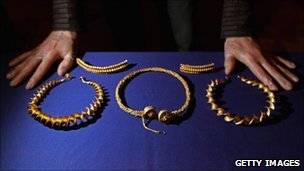
Il set di monili per il collo sono stati trovati in un campo vicino a Stirling.
Un cacciatore di tesori dilettanti che hanno portato alla luce un tesoro d'oro dell'età del ferro è in attesa per ricevere quasi 500.000 £ come ricompensa per la scoperta.
Il ritrovamento è datato al Settembre del 2009
L'oro, del valore di circa 1 milione di sterline, datato tra il 1 ° e 3 ° secolo aC.
Il tesoro sarà data ai Musei nazionali di Scozia, a condizione di pagare 462.000 £ al signor Booth.
Secondo la legge scozzese, la Corona può rivendicare alcun reperti archeologici trovati in Scozia.
Finders non hanno alcun diritto di proprietà e devono segnalare eventuali oggetti il tesoro Unit.
La decisione è stata annunciata dalla Regina e Lord Tesoriere Remembrancer Catherine Dyer, che come rappresentante della Corona in Scozia può pretendere sepolti reperti archeologici o storico.
La signora Dyer ha detto: "Questo ritrovamento è molto importante, è il tesoro più importante in oro dell'età del ferro mai trovato in Scozia.
"Il fatto che questi manufatti sono stati rinvenuti in ottime condizioni dopo essere stato sepolto per 2.000 anni è semplicemente incredibile".
Nel contesto dell'attuale difficile congiuntura economica, stiamo esplorando una serie di fonti di finanziamento per garantire quella che è la somma da riconoscere allo scopritore "
Dr Gordon Rintoul
Musei nazionali della Scozia
I quattro reperti in oro erano sepolti appena a sei centimetri sotto la superficie, quando il signor Booth li ha scoperti con il suo metal detector.
Il professor Ian Ralston, presidente della Safap, ha dichiarato: "Il pannello è grato al scopritore per aver segnalato questi reperti estremamente importanti, in tempo utile e per l'ulteriore assistenza durante il lavoro sul campo con il Museo Nazionale presso il sito della scoperta.
"Ciò ha consentito maggiore comprensione del contesto archeologico di questi quattro elementi eccezionali."
"Queste magnifiche collane d'oro Età del Ferro sono di importanza nazionale ed internazionale e siamo lieti che Musei Nazionali della Scozia avranno ora l'opportunità di acquisirli per la conservazione e la visualizzazione, " ha detto.
Originale in inglese:
An amateur treasure hunter who unearthed a hoard of Iron Age gold is in line to receive almost £500, 000 as a reward for the discovery.
David Booth found the four neck ornaments - or torcs - in a field near Stirling in September 2009 using a metal detector.
The gold, worth about £1m, dated from between the 1st and 3rd Century BC.
The treasure trove will be given to the National Museums Scotland, provided they pay £462, 000 to Mr Booth.
Continue reading the main story
Under Scots law, the Crown can claim any archaeological objects found in Scotland.
Finders have no ownership rights and must report any objects to the Treasure Trove Unit.
The Scottish Archaeological Finds Allocation Panel (Safap) has recommended the items be handed to the National Museums Scotland - provided they make the ex gratia award to Mr Booth.
'Amazing' condition
The decision was announced by the the Queen's and Lord Treasurer's Remembrancer Catherine Dyer, who as the Crown's representative in Scotland can claim buried archaeological or historic items.
Ms Dyer said: "This is a very significant find, the most important hoard of Iron Age gold ever found in Scotland.
"That these stunning artefacts have been unearthed in such excellent condition after being buried for 2, 000 years is simply amazing."
Continue reading the main story
"
The four torcs were buried just six inches beneath the surface when Mr Booth discovered them with his metal detector.
Professor Ian Ralston, chairman of Safap, said: "The panel is grateful to the finder for reporting these highly important finds in good time and for the further assistance from the finder during fieldwork by the National Museum at the site of the discovery.
"This has allowed much greater understanding of the archaeological context of these four exceptional items."
Dr Gordon Rintoul, National Museums Scotland director, said he would be looking at a number of ways to raise the money for the reward.
"These magnificent Iron Age gold torcs are of national and international importance and we are delighted that National Museums Scotland will now have the opportunity to acquire them for preservation and display, " he said.
"In the context of the current difficult economic climate, we will be exploring a range of sources of funding to secure what is a substantial sum to ensure these items remain available for future generations within the national collections."
Since the discovery, Mr Booth, the chief game warden at Blair Drummond Safari Park, has also found an 800-year-old medieval seal near Stirling.















di Michael A. Cremo, Richard L. Thompson2. Archeologia Misterica
di Luc Bürgin3. Archeologia dell'impossibile
di Volterri Roberto4. Archeologia eretica
di Luc Bürgin5. Il libro degli antichi misteri
di Reinhard Habeck6. Rennes-le-Château e il mistero dell'abbazia di Carol
di Roberto Volterri, Alessandro Piana7. Il mistero delle piramidi lombarde
di Vincenzo Di Gregorio8. Le dee viventi
di Marija Gimbutas9. Come ho trovato l'arca di Noè
di Angelo Palego10. Navi e marinai dell'antichità
di Lionel Casson

ARCHEOLOGIA BIBLICA
ECCEZIONALE RITROVAMENTO IN UN TUNNEL SEGRETO IN MESSICOARCHEOLOGIA BIBLICA
CIMITERO DI ANFORE IN DUE NAVI ROMANE NELLE EOLIEARCHEOLOGIA BIBLICA
SCOPERTI VASI DI ARGILLA CRUDI A POMPEIPALEONTOLOGIA
IL GIGANTE DI ATACAMA: UN ALTRO GEOGLIFO CHE SFIDA LA NOSTRA COMPRENSIONE DEL PASSATOARCHEOLOGIA BIBLICA
TROVATA AD ORVIETO LA TESTA DEL DIO DEGLI ETRUSCHIPALEONTOLOGIA
IL MISTERO DELLE TORRI SEGRETE DELL'HIMALAYAARCHEOLOGIA BIBLICA
UNO SCAVO ILLEGALE SCOPRE UN TEMPIO DI THUTMOSE IIIPALEONTOLOGIA
LA BUFALA CHE GESU' FU PADRE E MARITOPALEONTOLOGIA
IL "SEME MAGNETICO" CHE DIEDE VIA ALLA VITA VEGETALE SULLA TERRAPALEONTOLOGIA
TRAPPOLE PER DEMONI SCOPERTE IN INGHILTERRA
